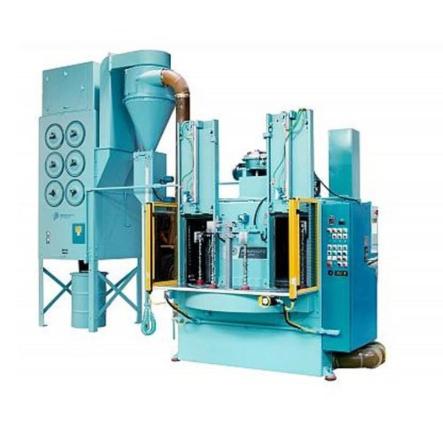
A Shot Peening Machine is commonly used for metal components. It increases the working performance, endurance, stability, and durability of metals. It is a cold working process that shoots abrasive media at the component, basically metal. The abrasives are made of steel shots, ceramic media, or glass beads. It can mechanically compress the surface of the material beyond its critical point. This procedure boosts fatigue strength, protects against stress corrosion cracking, and extends its service life. Industries such as aerospace, automotive, manufacturing industries, and heavy machinery commonly use shot peening to increase the durability of components exposed to repeated or cyclic stress.
Working Principles of the Shot Peening Machine
The Shot Peening Machine works on the principle of cold working. It uses a controlled mechanical impact to create advantageous compressive residual stresses on a material’s surface. The procedural steps are given below:
- Media Propulsion: This process essentially involves using compressed air to propel small spheres, or at least spheroid–shaped particles. These spheres, known as steel shot and steel grit, are thrown at high speed (between 40 and 120 m/s) onto a component’s surface. Propulsion is achieved through compressed air or centrifugal force.
- Surface Impact: Each shot hits the metal surface like a small hammer. The stress generated in the surface fibers must be greater than the material’s yield strength for the treatment to be effective. This allows the shots to plastically deform the surface, leaving a tiny imprint on it.
- Dimple Formation: Every shot leaves a small dent or dimple. Millions of such dimples overlap, forming a homogenous compressive stress layer on the surface.
- Residual Compressive Stress: This compressive layer prevents crack formation and propagation, thereby improving fatigue life and resistance to stress corrosion.
Key Components Of the Shot Peeing Machine
- Blast Chamber: This enclosed space houses the shot peening process, securely containing the high-speed media and preventing it from escaping into the surrounding environment.
- Nozzles: Directing and accelerating the peening media at precise speeds and angles is the function of the nozzles. Their construction is vital to the success of the peening process.
- Shot Conveying System: This part of the peening system includes hoppers and pipes for moving the shot from storage to the point of blasting.
- Work Handling Mechanism: This mechanism uses automated systems and a robotic XY manipulator to move and precisely position parts inside the last chamber, ensuring uniform and complete coverage.
- Control System: This system monitors and controls crucial process parameters such as air pressure, shot flow rate, impact angle, and the speed of the work handling system.
Types of Shot Peening Systems
The classification of shot peening machines depends on their propulsion method and on their different part handling system.
By Media Propulsion
- Air Blast Machines: These are also known as pneumatic machines. They use high-pressure air to force the shot particles onto the workpiece through a sand blasting nozzle. They are frequently used to clean difficult-to-reach places, small parts, and complex geometries.
- Airless Machines: These are called wheel blast devices. The shot media is projected using centrifugal force by means of a high-speed centrifugal shot blast wheel. Larger parts and higher-volume applications are effectively handled by these machines.
By Part Handling System
- Hanger Blast Machine: These machines are used for larger and more intricate parts. They clean all surfaces thoroughly by suspending the workpieces on a hanger. The hanger moves through the shot blasting cabinet.
- Table Blast Machines: These are used for larger and heavier workpieces that cannot be tumbled. The parts are positioned on a revolving table inside the blast chamber, which ensures uniform coverage.
Other Methods
- Laser Peeing: A media-free technique that applies compressive stress to a material’s surface. It uses a high-intensity laser.
- Ultrasonic Needle peening: This technique creates compressive stress by driving a needle against a surface using ultrasonic vibrations.
Applications of the Shot Peening Machine
Shot Peening Machines are widely used in numerous industries due to their ability to enhance the mechanical properties of metal components. Key applications of shot peening machines are outlined below.
- Aerospace Industries: The goal is to increase fatigue strength and stop stress corrosion cracking. Applications include:
- Landing gear for aircraft.
- Blades and discs of the turbine.
- Structural elements (Frames of the fuselage, wings).
- Engine components.
- Automotive Industries: The goal is to prolong the life and functionality of stressed components. Uses:
- Crankshafts, shafts, and gears.
- Springs for suspension (leaf spring, coil spring).
- Connecting rods.
- Components of a transmission.
- Power Generation: The goal is to increase fatigue resistance, corrosion, and high-temperature stress. Uses:
- Turbine blades of gas and steam.
- Generator shafts.
- Components of a wind turbine.
- Railways: Due to constant vibrations and loading. It can improve fatigue resistance. Uses:
- Suspension parts.
- Axles and wheels.
- Railway tracks (welded joints).
Key Features and Advantages of Shot Peening Machine
- The shot blasting machine offers adjustable parameters for accurate surface treatment.
- These machines include adjustable shot velocity, flow rate, and impact angle.
- For high-volume production, these machines offer a full automation system.
- It reduces man-power and increases productivity.
- Robotic arms and manipulators are used to amplify precision and repeatability for intricate parts.
- Machines are constructed from strong, wear-resistant materials to endure constant use in harsh industrial settings.
- Enclosed cabinets are used for the peening process to ensure operator safety and environmental compliance.
Manufacturers and Suppliers of Shot Peening Machines
The shot peening machine market is estimated in the hundreds of millions of USD globally. The expansion of manufacturing in India and Southeast Asia is driving the size and growth of the Asia-Pacific market on a regional scale. We are one of the leading shot peening machine manufacturers in India. Mature markets need more sophisticated, automated, and high-efficiency machinery in the automobile and aerospace industries. These machines are an investment in quality, productivity, and long-term savings. Extending the fatigue life of the components can reduce downtime, maintenance costs, and risk of accidents. One of India’s top producers and exporters of shot peening equipment is Aerowheel. As one of the leading manufacturers of shot peening machines in India, they have built a solid reputation for themselves. They assist many companies in a variety of sectors in enhancing the fatigue life and functionality of their parts.
Difference between Shot Peening Machine and Wheel Blast Machine
| Shot Peening Machine |
Wheel Blast Machine |
| To improve fatigue strength, stress resistance |
To remove rust, paint from surfaces |
| Induces controlled compressive stress on the surface |
Removes harsh materials from surfaces |
| Controlled actions like shot size, velocity |
For fast surface cleaning, High-Velocity media |
| Highly and precisely monitored process |
Less precise control |
| Used in aerospace, automotive springs, gears, and turbine blades |
used in Foundry parts, ship components |
| Amplify fatigue life and crack resistance |
Cleans the surface for painting or inspection. |